
Thermography
IN ANN ARBOR, MI
See what’s happening beneath the surface.
Your body is constantly communicating. A stiff neck, a sore knee that comes and goes, fatigue that lingers longer than expected. By the time you notice a pattern, the underlying issue has usually been brewing for a while.
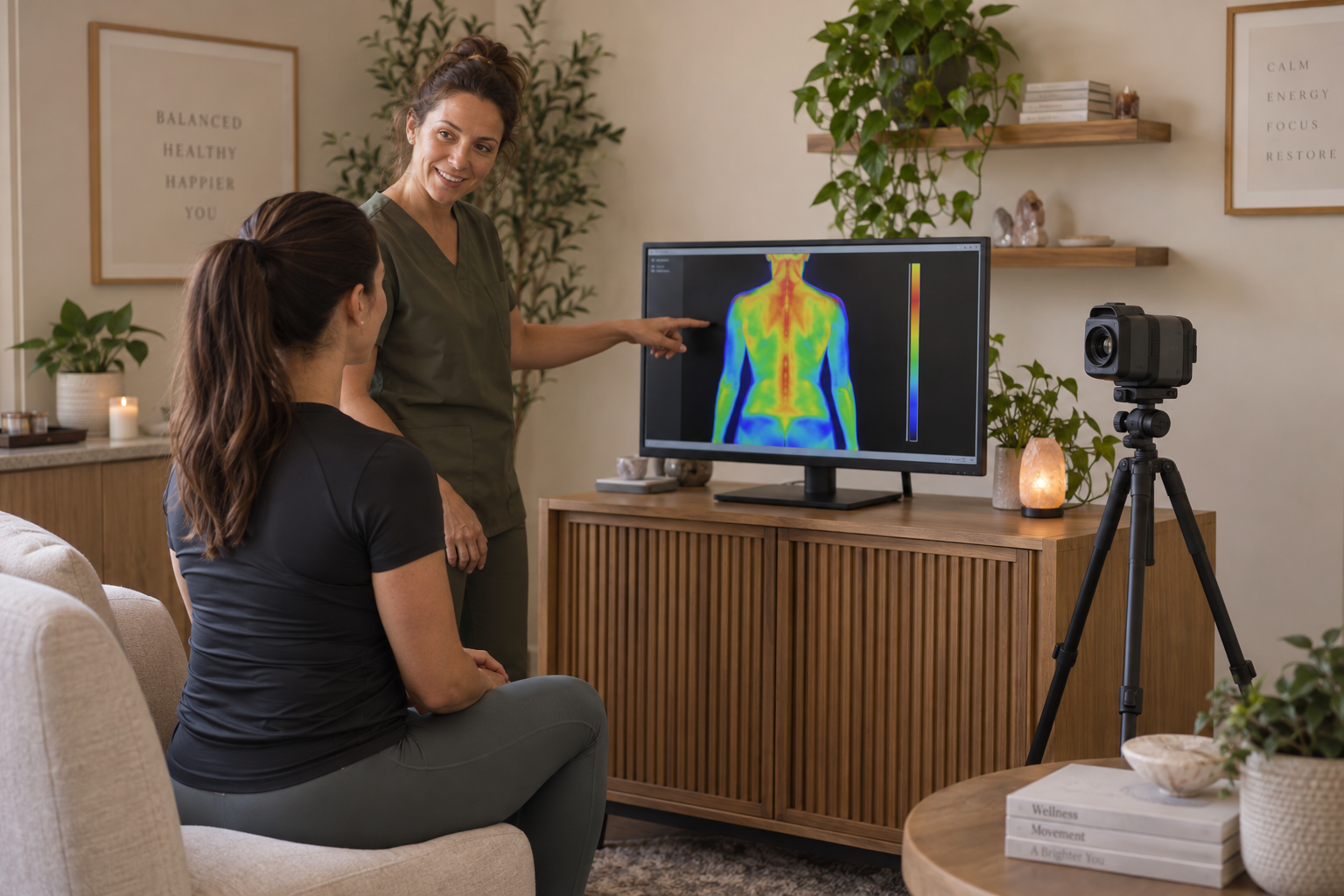
Clinical thermography gives you a window into what’s happening before symptoms become obvious. Thermography is a non-invasive imaging technique that uses highly sensitive infrared cameras to measure heat variations in your skin. Those thermal patterns can provide insight into inflammation, circulation changes, nervous system activity, and areas of stress throughout the body, caused by issues ranging from thyroid and digestive dysfunction to hormonal imbalances and muscle strains.
At Ann Arbor Holistic Health, we offer full-body thermography using clinical-grade infrared imaging technology in a calm, supportive environment. The process is completely radiation-free, painless, and requires no physical contact.
After your scan is interpreted by a trained specialist, an experienced AAHH wellness practitioner will help you understand how those results fit into the bigger picture of your health. For some, a thermogram offers a reassuring wellness baseline. For others, it’s the start of a deeper conversation about inflammation, lifestyle, stress, and individualized wellness support.


How Does Thermography Work?
Reading the Body’s Heat Map
Your body is constantly producing heat.
Every moment, your circulation, metabolism, immune system, muscles, and nervous system are generating tiny temperature changes across the surface of your skin. Most of those changes are invisible to the naked eye, but advanced infrared imaging technology can detect them.
Thermography uses a medical-grade infrared camera to capture those temperature patterns and translate them into detailed thermal images. Thermography has been used in integrative wellness settings, chiropractic clinics, and preventative health practices for decades as a non-invasive way to observe and track health changes.
Think of thermography scans like a weather map for your body. On a weather map, temperature patterns help meteorologists identify storms, pressure systems, or unusual activity before people experience the full impact on the ground. Thermography works similarly by identifying areas where the body may be functioning differently than expected.
For example:
Areas of increased heat may reflect inflammation, increased blood flow, or heightened physiological activity
Cooler regions may suggest reduced circulation or decreased tissue activity
Asymmetrical patterns between the left and right sides of the body can indicate imbalance or stress within a system
Thermography doesn’t attempt to replace other forms of imaging or diagnose a specific disease or condition. Instead, it offers an additional layer of information that can help identify patterns earlier, support proactive wellness decisions, and guide more personalized conversations about your health.


Benefits of Thermography
What Can Thermography Show?
Because it captures full-body thermal activity, thermography can provide insight across multiple systems at once. Here are some of the most common reasons clients choose thermography at Ann Arbor Holistic Health:
Inflammation Patterns
Inflammation is one of the body’s primary protective responses. However, chronic inflammation can contribute to fatigue, pain, slow recovery, and a wide range of long-term health concerns. Thermography can identify thermal patterns associated with inflammation, helping you better understand where your body may be under stress.
Circulatory & Vascular Insights
Healthy circulation affects everything from tissue repair and detoxification to energy levels and temperature regulation. Thermal imaging can provide information about blood flow patterns throughout the body, offering insight into areas that may benefit from additional support.
Nervous System & Stress Response
Your nervous system controls many of the automatic processes that keep you alive and functioning: circulation, breathing, sweating, heart rate, and temperature regulation. Because thermography captures changes in heat regulation, it can reflect patterns associated with chronic stress, nervous system dysregulation, or imbalances in your body’s stress response that you might not notice or understand.
Whole-Body Wellness
One of the most unique aspects of full-body thermography is the ability to step back and look at the body as an interconnected system, rather than a collection of isolated symptoms. Many clients appreciate having a broader physiological snapshot, especially when they’ve been trying to piece together seemingly unrelated concerns.
Proactive Wellness Monitoring
Thermography can help establish your personal thermal baseline. Because your heat patterns are as individual as a fingerprint, repeated scans can reveal subtle shifts in your body over time, making thermography a natural companion to routine functional lab work.
Is Thermography Right for Me?
Thermography is one of the most accessible imaging tools available. It’s non-invasive, radiation-free, requires no compression or physical contact, and most sessions are completed in under an hour.
Thermography tends to be especially well-suited for people who:
Want a broader understanding of how their body is functioning
Are interested in preventative or proactive wellness approaches
Suspect chronic inflammation may be contributing to symptoms
Feel like “something is off” and want more insight into possible patterns
Appreciate whole-body wellness approaches rather than isolated symptom management
Want to track changes in their health over time
For many Ann Arbor Holistic Health clients, thermography is a useful starting point for exploring deeper lifestyle patterns, nutrition support, stress regulation, or individualized practitioner guidance.
Are there any contraindications?
Thermography is considered safe for most adults, including those looking to avoid radiation-based imaging.
To ensure accurate imaging, there are several preparation guidelines we recommend before your appointment. These typically include avoiding vigorous exercise, saunas, heating pads, lotions, body creams, and temperature-altering activities prior to your scan so your natural thermal patterns can be captured as accurately as possible.
You’ll receive detailed preparation instructions before your session. If you have questions about whether thermography makes sense for your goals or situation, our team is always happy to help.




Thermography at Ann Arbor Holistic Health
Full-Body Infrared Imaging with Clinical-Grade Technology
Our practice uses a medical-grade infrared camera with 640 × 480 resolution and temperature sensitivity down to 0.01°C, well above the minimum standards set by professional thermography organizations. That precision matters: it’s the difference between a blurry snapshot and a detailed map.
A full-body thermography session at Ann Arbor Holistic Health typically takes 45–60 minutes, including intake and acclimatization. Here’s what to expect:
-
Accurate thermography requires a stable, controlled starting point, so we ask you to follow a short preparation protocol.
24 hours before: Avoid chiropractic care, massage, physical therapy, acupuncture, saunas, hot tubs, and heating pads.
4 hours before: No caffeine, alcohol, nicotine, or vigorous exercise. Skip hot showers.
Day of: Arrive with clean, bare skin in the areas being imaged – no deodorant, lotion, sunscreen, powder, or perfume. Wear loose, comfortable clothing. Remove jewelry before your scan.
-
You’ll begin with a 15-minute acclimatization period in our temperature-controlled imaging room, allowing your skin temperature to stabilize. Once acclimated, your practitioner will capture a series of standardized thermal images from several angles.
You’ll stand comfortably while the camera, positioned several feet away, does its work. No contact, no discomfort, and it’s over faster than most people expect.
-
Our specialized practitioner reviews and interprets your thermogram, and you’ll receive a detailed report highlighting areas of interest, thermal asymmetries, and any patterns worth monitoring. Because our team understands functional wellness, we can connect your thermal findings to your lab results, nutrition plan, or other services for a truly integrated picture.
During your session, you'll lie comfortably on the KLOUD mat for approximately 15 minutes. Most people feel nothing at all during the session, though some notice a subtle warmth or gentle tingling. There's no discomfort, no recovery time, and you can return to your day immediately after.
-
For health monitoring and comprehensive wellness baselines, we follow the industry-standard two-scan protocol: an initial scan establishes your unique thermal fingerprint, and a second scan approximately three months later confirms its stability.
Together, these two scans create the comparative baseline against which all future annual or semi-annual scans are measured. Our team can explain which protocol makes sense for your goals.

How does thermography pair with functional lab testing?
This is where Ann Arbor Holistic Health really stands apart. Thermography shows you where your body may be under stress. Functional labs, such as blood chemistry, hormone panels, gut health analysis, and food sensitivity testing, reveal the biochemical pathways involved.
When you layer these together, the result is a more complete and meaningful picture of your health than either tool provides alone.

Ready to See the Full Picture?
Thermography in Ann Arbor, MI

Most of us wait until something hurts to investigate. Thermography flips that script: it gives you a functional look at what’s happening in your body right now, without radiation or invasive procedures.
That means you can make informed decisions before small patterns become big problems. Whether you come for proactive wellness monitoring, a deeper understanding of chronic pain, or a functional complement to your existing care, thermography at Ann Arbor Holistic Health is a smart addition to your toolkit.
And our practitioners don’t just hand you an image and send you on your way. We help you interpret your results in the context of everything else we know about your health, and we’re here to help you take the next step.
Thermography FAQs
Answers to Common Questions About Thermography
-
No, thermography is not a replacement for traditional imaging like mammograms, MRIs, or x-rays. Thermography evaluates physiological activity and temperature patterns, while conventional imaging typically evaluates physical structure – whether something is torn, enlarged, or physiologically different than expected. The two approaches provide different types of information and are often used alongside one another.
-
Thermography measures infrared heat patterns and temperature variations at the skin’s surface. Those patterns can reflect underlying physiological activity related to circulation, inflammation, nervous system function, or tissue stress.
-
Most appointments take approximately 30–60 minutes total, including acclimation time before imaging begins. The imaging portion itself usually takes only a few minutes.
-
No, thermography is completely non-contact and radiation-free. The infrared camera simply detects heat naturally emitted from the body.
-
You’ll receive preparation instructions ahead of time. In general, you should avoid exercise, saunas, heating pads, lotions, body creams, and temperature-altering activities before your scan so the images reflect your body’s natural thermal baseline.
-
After your images are analyzed, an experienced practitioner will offer prompt guidance to help you interpret the findings and understand what patterns may deserve additional attention.
-
Because thermography does not use radiation, it can be safely repeated to monitor changes over time. Many clients use follow-up imaging to track progress related to inflammation, stress reduction, recovery, or their broader wellness goals.
-
Some clients simply use thermography as an informational wellness tool. Others choose to explore the findings further through practitioner-guided wellness support, functional nutrition coaching, or additional holistic services designed around their individual goals.
The information on this page is informed by published research, including guidelines from the American College of Physicians, the National Institutes of Health (NCCIH), and peer-reviewed studies indexed in PubMed. We review our content regularly to reflect current evidence.